
Discover the history of Olu Ginuwa I, the Benin prince whose migration established the Warri royal dynasty and the institution of the Olu of Iwere.
Biography
By Oritsegbubemi Adrian Edema
Who Was Olu Ginuwa I?
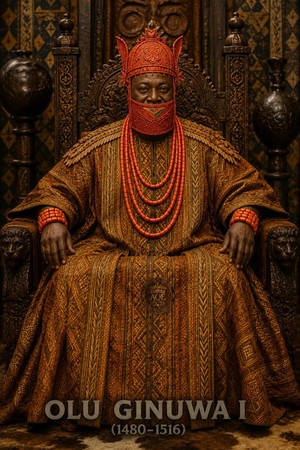
Olu Ginuwa I, also rendered in historical sources as Ginuwa or Iginuwa, occupies a foundational place in the history of the Warri Kingdom, traditionally known as Iwere. He was a prince of the Benin royal house who migrated from Benin into the western Niger Delta during the fifteenth century and became the first ruler of the royal dynasty from which the institution of the Olu of Warri developed.
William A. Moore’s History of Itsekiri, first published in 1936 and reissued by Frank Cass in 1970, preserves one of the most extensive written versions of the Itsekiri oral traditions concerning Ginuwa. The 1970 edition is particularly important because it includes an introduction by anthropologist P. C. Lloyd, who compared Moore’s narrative with subsequent historical and ethnographic research. Lloyd observed that the tradition of Ginuwa’s departure from Benin is also reflected in Benin historical traditions.
Ginuwa’s arrival should not, however, be interpreted as the beginning of settlement or human history in Iwere. Moore’s own historical notes describe populations already living throughout the region before the arrival of the Benin prince. Later historical analysis likewise distinguishes these earlier communities from the establishment of the royal dynasty associated with Ginuwa.
It is therefore more historically precise to regard Olu Ginuwa I as the founder of the Warri royal dynasty and the first Olu of Iwere, rather than as the founder of the Itsekiri people themselves.
Royal Origins in the Benin Kingdom
According to the traditions recorded by both Benin and Itsekiri historians, Ginuwa was the son of Oba Olua, whose name also appears in older accounts in forms such as Nuwa, Onuwa or Oluwa. Olua belonged to the royal house of Benin and was a son of the celebrated Oba Ewuare, one of the most important rulers in the history of the Benin Kingdom.
Jacob U. Egharevba’s A Short History of Benin identifies Olua as an Oba of Benin and preserves the Benin version of the political circumstances surrounding his son Iginuwa. In Egharevba’s account, Iginuwa had become unpopular in Benin because of advice he had given his father concerning the people. Recognising that this hostility could threaten his son’s future, Olua arranged for a kingdom to be established for him towards the coastal region. The relevant account appears in the discussion of Olua in the fourth edition of Egharevba’s work.
Later traditions sometimes give Ginuwa’s birth as around 1445 and describe him as having grown up within the Benin royal court. The exact year of his birth, however, cannot presently be established from contemporary fifteenth-century documentation. For WarriHeritage, c. 1445 should therefore be treated as a traditional or approximate date rather than a firmly documented birth year.
The traditions consistently present Ginuwa as the senior son chosen for an important political destiny. Moore describes him specifically as Nuwa’s eldest son.
Ginuwa and the Political Crisis in Benin
The traditions surrounding Ginuwa’s departure are as much about royal politics as migration.
Egharevba’s Benin account describes Iginuwa as having become disliked because of the severe advice he gave his father concerning opponents within the kingdom. Moore’s Itsekiri account approaches the episode from a somewhat different direction but similarly presents political instability at Benin as the background to Ginuwa’s departure.
These accounts should be understood as historical traditions preserved centuries after the events, rather than eyewitness records. Nevertheless, their agreement on the essential relationship between Ginuwa, the Benin royal house and his departure towards the Niger Delta gives the core migration tradition considerable historical importance.
P. C. Lloyd, reviewing the traditions in 1969, concluded that the story of Ginuwa’s departure from Benin was corroborated by Benin legends, although he proposed that the migration may have occurred somewhat earlier than Moore’s traditional date of 1480.
This difference is important. It demonstrates why fifteenth-century dates associated with Olu Ginuwa I should usually be written with terms such as “about,” “around” or “traditionally dated to”, rather than presented as exact modern calendar dates.
The Iroko Ark and the Sons of the Seventy Chiefs
One of the most famous episodes in the Ginuwa tradition concerns the Iroko ark.
In Moore’s account, Nuwa consulted Ogifa, the Chief Oracle Diviner of Benin, concerning his son’s future. The divination called for an Iroko box or ark in which Ginuwa, the first-born sons of seventy chiefs, their attendants and property would travel towards the waterside.
The Oba subsequently summoned the chiefs and informed them that a sacrifice was to be taken towards the water through Ugharegin. He requested that their first-born sons accompany the expedition. According to the tradition, the chiefs agreed without understanding the full intention behind the journey.
Moore records that the ark was eventually conveyed from Benin to Ugharegin and places the beginning of the journey at about A.D. 1480. He also states that the overland journey from Benin City to Ugharegin took approximately three days.
At Ugharegin, Ginuwa emerged dressed in royal regalia and demanded to know whether his companions would follow him to his destination. Moore’s account states that they acknowledged his authority and agreed to accompany him.
In Itsekiri oral tradition, Ginuwa is additionally remembered as planting his staff at Ugharegin as a symbolic act marking the beginning of a territory distinct from that of his father. This detail belongs principally to the oral-traditional strand of the narrative and should be presented as such rather than as an independently documented fifteenth-century event.
The Escape from Ugharegin
The narrative continues with the discovery in Benin that the sons accompanying Ginuwa had not returned.
According to Moore, warriors were dispatched to Ugharegin to recover them. Ginuwa and his party were initially unable to move the ark into the water. The tradition says that Ginuwa then appealed to Umalokun, associated with the sea and waters, promising an annual sacrifice if he escaped his pursuers.
The waters subsequently rose sufficiently for the ark to float away before the Benin force reached it. Moore links this episode with the tradition surrounding Umalokun Olaja and records that its priest was associated with Ureju.
For the historian, the supernatural elements of this narrative should be understood within their proper cultural setting. They are part of the sacred and dynastic memory through which the migration has been transmitted across generations. WarriHeritage should preserve such traditions while identifying them clearly as oral or religious tradition, rather than attempting to convert them into modern empirical claims.
From Efurokpe to the Niger Delta Coast
Moore’s account describes a long migration through the waterways of the western Niger Delta.
The first recorded stopping place after Ugharegin was Efurokpe on the Jamieson River. Here, according to the tradition, Ginuwa’s sister Oyeifo remained because she was approaching childbirth.
Ginuwa’s party then continued through Arun-owun into the Escravos River and eventually settled at Amatu, also identified in Moore’s account as Aleodiaja or Dighinni.
Moore describes the group as remaining there for an extended period before moving again because the sandy coastal environment was unsuitable for agriculture and exposed to the sea.
The migration story is significant because it presents the establishment of the Warri monarchy not as a single journey from Benin directly to one final capital, but as a gradual process of movement, settlement, adaptation and interaction with communities already inhabiting the Niger Delta.
P. C. Lloyd similarly concluded that Ginuwa appears first to have settled near the mouth of the Forcados River and that the permanent royal centre at Ode-Itsekiri developed later under his successors.
Ureju and the Tradition of Orode
An important strand of Itsekiri oral tradition connects Ginuwa with Ureju.
According to this tradition, during his migration Ginuwa reached Ureju, where a woman remembered as Orode was given to him. She is traditionally associated with the birth of Prince Ijijen and Prince Irame, both of whom became central figures in the continuation of the dynasty.
The name of Ginuwa’s consort is not uniform across all modern accounts. Some Warri royal historical material identifies the mother of Ijijen as Urowoli of Ureju, while another transmitted version uses the name Orode.
Because these forms differ, WarriHeritage should preserve the specific oral tradition while noting the variant instead of silently selecting one spelling as indisputable fact.
Both sons became important to the royal succession. Ijijen succeeded Ginuwa, while Irame subsequently became another Olu of Iwere.
Oruselemo and Derumo
From the coastal settlements, Ginuwa eventually moved to Oruselemo.
Moore records that while living there he married an Ijaw woman named Derumo. The marriage reflects an important feature of early Warri history: interaction between Ginuwa’s migrant royal entourage and established Niger Delta communities.
According to Moore’s traditional account, a serious dispute later arose involving Derumo and the Ijaws of Gulani. Derumo was killed by Ginuwa, after which her people prepared for conflict.
The narrative says that Ginuwa instructed his followers to mourn Derumo publicly and persistently. Their mourning persuaded the opposing group that her death could not have been deliberate, and the immediate attack was abandoned. Fearing that the circumstances might later become known and hostilities renewed, Ginuwa eventually decided to leave Oruselemo.
This episode comes to us through Moore’s recording of Itsekiri oral history. In a modern heritage publication it should therefore be attributed directly to that tradition rather than written as though its detailed dialogue and motivations were preserved in contemporary records.
Idibie and the Move to Ijala
By the time Ginuwa prepared to leave Oruselemo, the figure Idibie had joined his party.
Moore describes Idibie as a great doctor or diviner. Ginuwa asked him to identify a safer place for settlement. After consulting his oracle, Idibie guided the group to Ijala, where they established a settlement.
Ijala consequently occupies an exceptional position in the history of the Warri royal house.
It was there that Ginuwa spent the final phase of his life according to the traditional narrative, and it was at Ijala that he was eventually buried.
Moore records that Ginuwa died there after a short illness. Because the first Olu was buried at Ijala, the place acquired enduring importance in the burial traditions of the Warri monarchy.
Was Ginuwa the Founder of the Warri Kingdom?
The answer requires an important distinction.
Ginuwa was unquestionably the foundational monarch of the dynasty and is remembered as the first Olu. His migration created the royal institution that came to dominate the political history of Iwere.
However, Moore himself entitled the chapter following Ginuwa’s death “Establishment of Warri Kingdom by Ijijen.” In his narrative, Ginuwa died at Ijala before the final move to Iwere, after which his senior son Ijijen assumed his father’s authority and led the party onward to the settlement associated with Ode-Itsekiri.
Lloyd likewise concluded that Ginuwa initially settled near the Forcados region and that his successors later established the capital at Ode-Itsekiri.
The most accurate formulation is therefore:
Olu Ginuwa I founded the royal dynasty and institution of kingship from which the Warri Kingdom developed, while the political consolidation and establishment of the permanent royal centre continued under his successors, particularly Olu Ijijen.
This distinction preserves Ginuwa’s central place in Warri history without erasing the contributions of the communities already present in Iwere or the work of the rulers who followed him.
Ginuwa and the First Portuguese Contact
One of the most fascinating aspects of the Ginuwa tradition concerns early contact with Europeans.
Moore states that it was at Ijala that the Portuguese first came into contact with Ginuwa, giving the date as approximately 1516. In a later chapter devoted specifically to the Portuguese, he repeats the date and describes a Portuguese sailing vessel appearing in the Warri River area.
According to Moore’s narrative, local women fishing in small canoes first observed the unfamiliar vessel. Initial uncertainty eventually gave way to peaceful exchange, and relations between the newcomers and Ginuwa’s people began through trade.
This episode became part of the much longer history of relations between the Warri Kingdom and Portugal.
Portuguese contact would later become far more significant during the reigns of subsequent Olus. P. C. Lloyd’s examination of later documentary evidence notes that Portuguese influence became particularly strong towards the end of the sixteenth century and that members of the Warri royal family subsequently travelled abroad and participated in sustained diplomatic, commercial and Christian contacts with Portugal.
A Note on the Date 1516
The date requires caution.
Moore places Ginuwa alive at Ijala at approximately 1516. Some modern lists of the Olus, however, conventionally give Ginuwa’s reign as approximately 1480–1510.
Those dates cannot both be treated as exact.
Moreover, P. C. Lloyd cautioned that oral histories can compress or extend events by attributing developments from different periods to a particularly important ruler. His analysis of Moore demonstrates that the earliest chronology of the kingdom should not be read like a modern year-by-year court register.
For this reason, WarriHeritage treats dates associated with the earliest Olus as approximate traditional chronologies unless supported by independent contemporary documentation.
The Death of Olu Ginuwa I and the Succession of Ijijen
Ginuwa died at Ijala, according to Moore’s account, and was buried there.
His death did not end the royal project he had begun.
His sons Ijijen and Irame were already adults in Moore’s narrative. As the senior son, Ijijen assumed his father’s authority and led the royal party from Ijala towards Iwere, establishing the next stage in the development of the kingdom.
Ijijen became the second ruler in the Ginuwa dynasty and was subsequently followed by Irame.
Through them, the royal line established by Ginuwa survived and developed into one of the best-known monarchies of the Niger Delta.
The Historical Legacy of Olu Ginuwa I
The importance of Olu Ginuwa I extends far beyond his personal reign.
His migration represents the beginning of a new political institution within Iwere: a centralised kingship whose ruling dynasty traced its immediate royal ancestry to Benin while developing within the distinctive linguistic, cultural and geographical environment of the western Niger Delta.
The traditions surrounding him also preserve memories of interaction among different peoples and communities—Itsekiri-speaking populations, Benin migrants, Ijaw communities and others who inhabited or moved through the creeks and coastal settlements of the region.
Ginuwa’s story therefore should not be reduced to a simple account of one prince leaving Benin and founding a town.
It is the history of dynastic formation, migration, political negotiation, cultural interaction and adaptation to the Niger Delta environment.
The monarchy that emerged from this process became the central institution of the Warri Kingdom. Generations of Olus subsequently expanded its political organisation and developed commercial and diplomatic relationships extending far beyond the Niger Delta.
For the Itsekiri people, Ginuwa remains the ancestral founder of the royal dynasty and the first figure in the succession of Olus whose institution continues into the modern era.
His life marks the beginning of an enduring chapter in the history of Iwere and the Warri Kingdom.
Historical Note
The life of Olu Ginuwa I belongs to a period for which there are very few surviving contemporary written records. Much of the detailed narrative was preserved through oral tradition before being committed to writing centuries later.
WarriHeritage therefore distinguishes among:
- oral traditions, which preserve community memory and cultural interpretation;
- early written histories, particularly William A. Moore and Jacob U. Egharevba;
- later historical and anthropological scholarship, which compares those traditions with archival and documentary evidence.
Where exact dates or details differ between traditions, WarriHeritage identifies the uncertainty rather than presenting one version as indisputable historical fact.